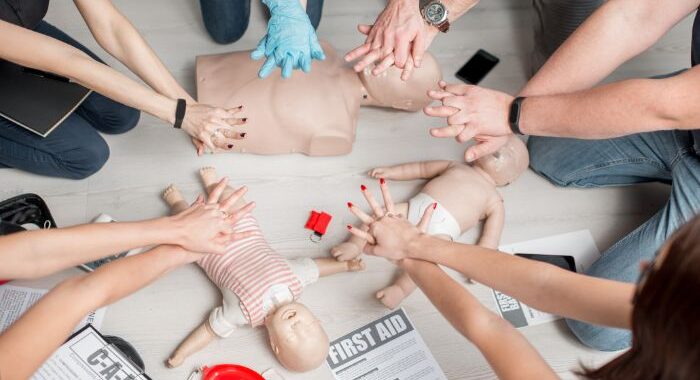
Understanding the language of First Aid could save a life. Here, the team at Lightning Training Solutions breaks down the most important First Aid acronyms used in the UK today.
When an emergency happens, there is no time to think. The best First Aid responders act quickly, calmly and systematically. That is exactly why First Aid acronyms exist. These short, memorable codes give trained responders a clear mental framework to follow under pressure, ensuring nothing is missed when every second counts.
From the moment you approach a casualty to managing a sprain or recognising a stroke, there is an acronym designed to guide you. In this post, we explain the most widely used First Aid acronyms in the UK, what they stand for, and why knowing them could make all the difference.
DR ABC: The Foundation of Every First Aid Response
DR ABC is the cornerstone of adult First Aid in the UK. Recommended by the Resuscitation Council UK, it is the first framework taught on our First Aid at Work courses and forms the bedrock of all casualty assessment.
| Letter | Stands For | What to Do |
|---|---|---|
| D | Danger | Check for danger to yourself, bystanders and the casualty before approaching |
| R | Response | Check if the casualty responds. Shout “Can you hear me?” and tap their shoulders |
| A | Airway | Open the airway by tilting the head back and lifting the chin |
| B | Breathing | Look, listen and feel for normal breathing for no more than 10 seconds |
| C | Circulation / CPR | If not breathing normally, call 999 and begin CPR immediately |
The Resuscitation Council UK reports that effective bystander CPR can double or even triple a person’s chance of survival following cardiac arrest. Knowing DR ABC and acting on it without hesitation is the difference between life and death.
Key Fact: According to the British Heart Foundation, fewer than 1 in 10 people survive an out-of-hospital cardiac arrest in the UK. Immediate CPR and defibrillation dramatically improve those odds.
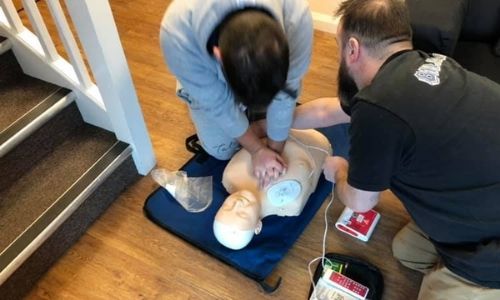
AVPU: Assessing a Casualty’s Level of Consciousness
Once you have completed your initial DR ABC assessment, AVPU helps you quickly assess how alert and responsive a casualty is. It is used by paramedics, nurses and trained First Aiders alike, and is a standard tool recommended by NHS clinical guidelines.
| Letter | Stands For | Meaning |
|---|---|---|
| A | Alert | The casualty is fully awake, aware and responsive |
| V | Voice | The casualty only responds when you speak to them |
| P | Pain | The casualty only responds to a painful stimulus (such as a firm pinch) |
| U | Unresponsive | The casualty does not respond to any stimulus |
An ‘Alert’ result is reassuring. A ‘Pain’ or ‘Unresponsive’ result is a serious indicator that emergency services must be called immediately.
AVPU is particularly useful in situations involving head injuries, seizures, diabetic emergencies or suspected strokes. It gives responders and arriving paramedics a fast, objective snapshot of the casualty’s neurological status.
Did You Know? The Glasgow Coma Scale (GCS), used by hospitals and paramedics, builds on the same principles as AVPU but provides a more detailed score out of 15. AVPU is the rapid field version, designed for use by First Aiders in real-world emergencies.
FAST: Recognising a Stroke
Every year, around 100,000 people have a stroke in the UK, according to the Stroke Association. Stroke is a medical emergency, and the FAST acronym is the NHS-endorsed tool for recognising one quickly.
Time is brain. For every minute a stroke goes untreated, approximately 1.9 million neurons die. Acting on FAST could save someone’s life and significantly limit long-term disability.
| Letter | Stands For | What to Look For |
|---|---|---|
| F | Face | Has their face drooped on one side? Can they smile? |
| A | Arms | Can they raise both arms and keep them there? |
| S | Speech | Is their speech slurred, confused or unable to speak? |
| T | Time | Time to call 999 immediately if you spot ANY of the above |
If you notice any of these signs, do not wait to see if they improve. Call 999 straight away and note the time the symptoms began. This information is critical for the medical team.
Key Statistic: NHS England data shows that prompt treatment (within the “golden hour”) can significantly reduce the severity of a stroke. Awareness of FAST saves lives every day across the UK.
Our blog post on Recognising and Responding to Strokes explores this in much greater detail, including how First Aid training prepares you to respond confidently in those critical first minutes.
RICE: Managing Sprains, Strains and Soft Tissue Injuries
Not every First Aid situation involves an unconscious casualty. Soft tissue injuries such as sprains and strains are among the most common workplace and sporting injuries in the UK. RICE is the standard First Aid management approach for these injuries.
| Letter | Stands For | What to Do |
|---|---|---|
| R | Rest | Stop the activity and rest the injured area immediately |
| I | Ice | Apply an ice pack (wrapped in a cloth) for 20 minutes every 2 hours |
| C | Compression | Apply a firm bandage to reduce swelling |
| E | Elevation | Raise the injured limb above heart level to reduce swelling |
RICE should be applied as soon as possible after injury. It reduces inflammation, controls pain and promotes healing. According to NHS guidance, most minor sprains and strains treated with RICE heal within 2 to 8 weeks depending on severity.
Important Note: If you suspect a fracture, dislocation or if the casualty cannot bear weight, always seek medical attention. Do not attempt to move or straighten a suspected broken bone.
Some First Aid educators have updated RICE to PRICE (adding Protection) or POLICE (Protection, Optimal Loading, Ice, Compression, Elevation), which reflects more recent sports medicine guidance. At Lightning Training Solutions, our trainers teach the most current, evidence-based approaches on all our practical courses.

CARE: First Aid for a Conscious Choking Adult
Choking is one of the most frightening First Aid emergencies. In the UK, choking kills around 230 people every year, according to St John Ambulance. Acting quickly and correctly is vital.
CARE provides a clear sequence for responding to a conscious choking adult:
| Letter | Stands For | What to Do |
|---|---|---|
| C | Call for help | Shout for help and ensure someone calls 999 if needed |
| A | Ask | Ask “Are you choking?” A person who can cough or speak is not severely blocked |
| R | Re-assure and back blows | Give up to 5 firm back blows between the shoulder blades |
| E | Emergency abdominal thrusts | If back blows fail, give up to 5 abdominal thrusts (Heimlich manoeuvre) |
If the obstruction is not cleared after 3 cycles of back blows and abdominal thrusts, call 999 immediately if you have not already done so.
Paediatric Alert: The technique for a choking child is different from that for an adult, and abdominal thrusts should NEVER be used on a baby under 1 year old. If you care for or work with children, a Paediatric First Aid course is essential.
SAMPLE: Taking a Casualty History
When emergency services arrive, the information you hand over could be as important as the First Aid you have already given. SAMPLE is a structured way to gather and retain key information about a casualty.
| Letter | Stands For | Example Questions |
|---|---|---|
| S | Signs and Symptoms | “What can you feel? Where does it hurt?” |
| A | Allergies | “Do you have any known allergies?” |
| M | Medications | “Are you taking any medication?” |
| P | Past Medical History | “Do you have any medical conditions?” |
| L | Last Oral Intake | “When did you last eat or drink anything?” |
| E | Events Leading Up | “What were you doing when this happened?” |
SAMPLE is widely used by paramedics and emergency nurses in the UK and is taught as part of advanced First Aid qualifications. Having this information ready when the ambulance arrives helps the medical team make faster, better-informed decisions.
STOP: Managing Bleeding
Uncontrolled bleeding is one of the leading causes of preventable death following trauma. STOP is a simple, memorable framework for managing significant bleeding in a First Aid situation.
| Letter | Stands For | What to Do |
|---|---|---|
| S | Sit or lie the casualty down | Position them appropriately to reduce blood flow and shock |
| T | Tell them to apply pressure | Encourage the casualty to press firmly on the wound with their hand |
| O | Other dressings | Apply a clean dressing or pad and maintain firm pressure |
| P | Pressure maintained | Keep consistent, firm pressure for at least 10 minutes without lifting |
If blood soaks through the dressing, do not remove it. Apply another pad on top and continue pressing. Removing the pad disrupts clot formation.
UK Statistic: According to the British Red Cross, approximately 150,000 people a year die from injuries that are potentially survivable. Many of these deaths involve treatable blood loss. First Aid training teaches you how to respond confidently in these moments.

Why Learning These Acronyms Is Only the Start
Reading about First Aid acronyms is a great first step. But knowing what DR ABC, AVPU or RICE stands for is very different from being able to use them confidently in a real emergency.
That is why hands-on, practical training matters so much.
At Lightning Training Solutions, our experienced trainers have real-world backgrounds in the Military, Emergency Services and the NHS. They do not just teach you the theory. They put you in realistic scenarios where you practise these frameworks until they become second nature.
Our courses cover all of these acronyms in depth, in context, and with plenty of opportunity to practise:
- First Aid at Work (FAW) covers DR ABC, AVPU, FAST, SAMPLE, STOP and more across a comprehensive 3-day qualification.
- Emergency First Aid at Work (EFAW) is our 1-day course ideal for lower-risk workplaces, covering the essential responses including DR ABC, RICE and CARE.
- Paediatric First Aid applies these frameworks specifically to infants and children, with adaptations that are critical when dealing with younger casualties.
- Mental Health First Aid introduces frameworks for recognising and responding to mental health crises, which are increasingly important in modern workplaces.
We deliver training across Somerset and the surrounding areas, including at your own premises, 7 days a week. Our courses are practical, engaging and delivered by people who have used these skills in real emergencies.
Ready to Go Beyond the Acronyms?
Whether you are an individual looking to feel more confident in an emergency, or a business with a legal duty to ensure your staff are trained, Lightning Training Solutions has a course for you.
Get in touch with our team today to find out more about our First Aid courses and how we can tailor training to your specific needs.
Call us on 01935 473575 or you can email us at bookings@lightningtrainingsolutions.co.uk to find the right First Aid course for you.
Lightning Training Solutions delivers First Aid and health and safety training across Somerset and the South West. Our trainers bring over 25 years of experience and real frontline expertise to every course we deliver.