Summer in the UK is something to be celebrated. Whether you’re heading to the coast, firing up the BBQ, loading the car for a family holiday, or simply enjoying the garden, the warmer months bring a welcome change of pace for millions of us.
But summer also brings its own unique set of risks – and the statistics make sobering reading.
Each year, thousands of people across the UK are treated for heat-related illness, insect stings, drowning incidents, road traffic collisions, and outdoor injuries during the summer months.
Many of these situations are entirely manageable with the right knowledge and some, without it, can quickly become life-threatening.
This guide has been put together by us to give you practical, no-nonsense First Aid advice for the most common summer emergencies.
From recognising heatstroke on a hot day, to knowing what to do if a child is stung by a wasp, or understanding what should be in your car First Aid kit before you set off on holiday.
Whether you’re a parent, a teacher, an outdoor worker, or simply someone who wants to feel more confident in an emergency then this guide is for you.
And if it leaves you wanting to go further, we’d love to help. We highly recommend taking a look at our upcoming First Aid courses in Yeovil because the best time to learn First Aid is before you ever need it.
First Aid isn’t just for the workplace. It’s for every barbecue, every beach trip and every family day out.
Recognising and Responding to Heat Exhaustion and Heatstroke
As UK summers become increasingly unpredictable, knowing how to recognise and respond to heat-related illness is no longer optional. It could save someone’s life.
Heat Exhaustion vs Heatstroke: Know the Difference
These two conditions are often confused, but they require very different responses.
Heat Exhaustion
Heat exhaustion occurs when the body overheats but is still able to regulate its temperature through sweating. It is serious, but with prompt First Aid most people recover fully within 30 minutes.
Symptoms include:
- Heavy sweating
- Dizziness, weakness or fatigue
- Nausea or vomiting
- Cool, pale, clammy skin
- A fast, weak pulse
- Muscle cramps
- Headache
What to do:
- Move the person to a cool place immediately, ideally indoors or into shade
- Lay them down and raise their legs slightly
- Remove any unnecessary clothing
- Cool them down with a damp cloth, cold water spray or fan
- Give small, frequent sips of cold water
- Monitor them closely, and call 999 if they do not improve within 30 minutes

Heatstroke
Heatstroke is a medical emergency. The body’s temperature regulation has failed entirely, and without urgent treatment it can cause organ failure and death.
Symptoms include:
- A high body temperature, above 40°C
- Hot, dry skin that has stopped sweating
- Confusion, disorientation or loss of consciousness
- Rapid, strong pulse
- Seizures
What to do:
- Call 999 immediately
- Move the person to a cool environment
- Cool them down as rapidly as possible, using cold wet towels, ice packs to the neck, armpits and groin, or immersion in cool water if safe to do so
- Do not give them anything to drink if they are confused or unconscious
- Stay with them until emergency services arrive
Who Is Most at Risk?
Whilst anyone can be affected by heat-related illness, certain groups are particularly vulnerable:
- Children and babies, whose bodies heat up three to five times faster than adults
- Older adults, particularly those over 75
- Outdoor and manual workers, including those in construction, agriculture, and forestry
- People with chronic health conditions, including heart disease, diabetes, and respiratory conditions
- Those taking certain medications, including diuretics and antihistamines
Preventing Heat-Related Illness
The best First Aid is prevention.
Key steps include staying hydrated by drinking regularly throughout the day, avoiding strenuous activity during the hottest part of the day (typically 11am to 3pm), wearing loose, light-coloured clothing, and never leaving children or animals in parked vehicles, even briefly.
A car parked in direct sunlight can reach 47°C within an hour.
Kids and Summer: First Aid Every Parent Should Know
Summer should be full of happy memories for children. But the combination of excitement, outdoor activity, water, sun, and food means that the warmer months also bring a higher risk of accidents and medical emergencies for young people.
In fact, the Royal Society for the Prevention of Accidents (RoSPA) reports that accidents involving children peak significantly during the summer holidays.
Here are the situations parents, carers, and school staff are most likely to encounter.
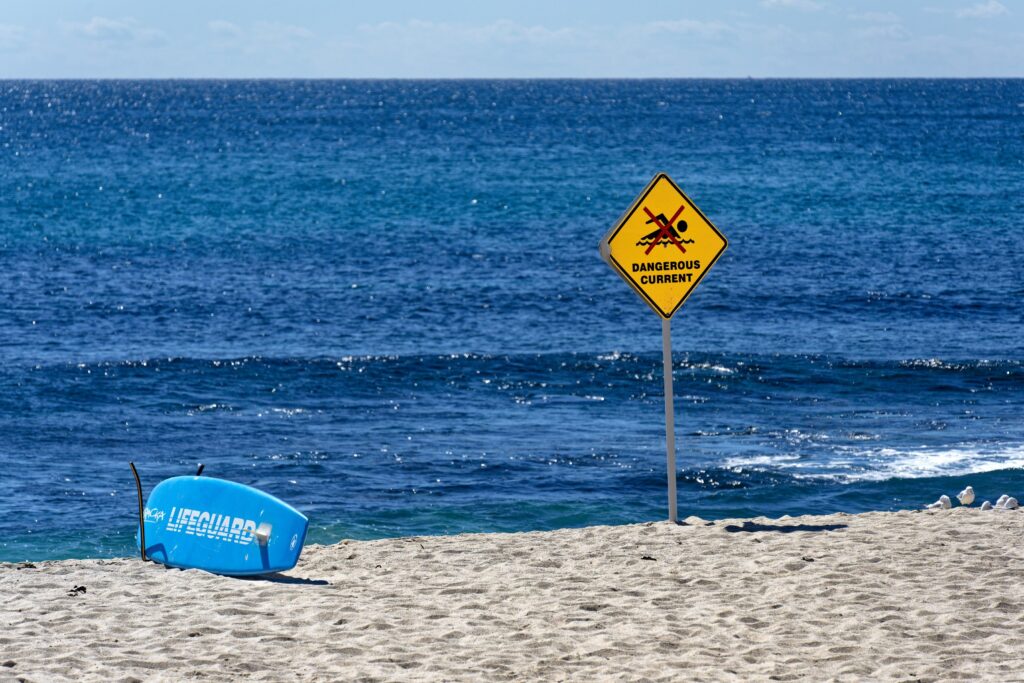
Drowning and Water Safety
Drowning is one of the leading causes of accidental death in children in the UK. Critically, it is often silent. A drowning child rarely shouts or waves for help in the way most people imagine.
Key facts:
- Around 400 people drown in the UK every year
- Children can drown in as little as 5cm of water, including paddling pools, garden ponds, and bathtubs
- Most childhood drownings occur within a short distance of safety and within sight of adults
What to do if a child is in difficulty in water:
- Do not enter the water yourself unless you are a trained lifeguard. You risk becoming a casualty too
- Shout for help and call 999 immediately
- Throw something that floats, a ball, a cool box, a lifebuoy, or a rope if available
- Once the child is out of the water, if they are unresponsive and not breathing normally, begin CPR immediately and continue until emergency services arrive
Paediatric CPR differs from adult CPR.
If you care for or work with children, our Paediatric First Aid course covers exactly this, giving you the confidence to act quickly and correctly in a water-related emergency.
Sunburn in Children
Sunburn in children is both common and serious. Repeated sunburn in childhood significantly increases the risk of skin cancer in later life.
First Aid for sunburn:
- Move the child out of the sun immediately
- Cool the skin with cool (not cold) running water for at least 10 minutes
- Apply a gentle, fragrance-free moisturiser or after-sun lotion. Do not use butter, oil, or ice
- Give child-appropriate pain relief such as paracetamol or ibuprofen if needed
- Ensure they drink plenty of fluids to rehydrate
- Seek medical advice if the child develops blistering, a high temperature, chills, or appears unwell
Febrile Seizures
Febrile seizures are fits triggered by a sudden spike in body temperature and are most common in children aged between 6 months and 5 years.
They affect approximately 1 in 30 children in the UK and, whilst frightening to witness, are usually harmless and brief.
Hot weather increases the risk of febrile seizures in young children, particularly if they are also unwell.
What to do:
- Stay calm and stay with the child
- Note the time the seizure starts
- Gently place the child on a soft, flat surface away from anything that could cause injury
- Do not restrain them or put anything in their mouth
- Once the seizure stops, place them in the recovery position
- Call 999 if the seizure lasts longer than 5 minutes, if it is their first seizure, or if you are unsure of the cause
Choking at BBQs
Summer BBQs are a wonderful tradition, but they are also a common setting for choking incidents in young children. Hard foods such as grapes, cherry tomatoes, sausages, and corn on the cob are among the most frequent culprits.
If a child is choking:
- Encourage them to cough if they are able to
- Give up to 5 back blows between the shoulder blades using the heel of your hand
- If unsuccessful, give up to 5 abdominal thrusts (for children over 1 year old)
- Alternate between back blows and abdominal thrusts
- Call 999 if the obstruction does not clear
For babies under 1 year, abdominal thrusts must never be used. The technique is different and is covered in full on our Paediatric First Aid course.
A Note on Paediatric First Aid Training
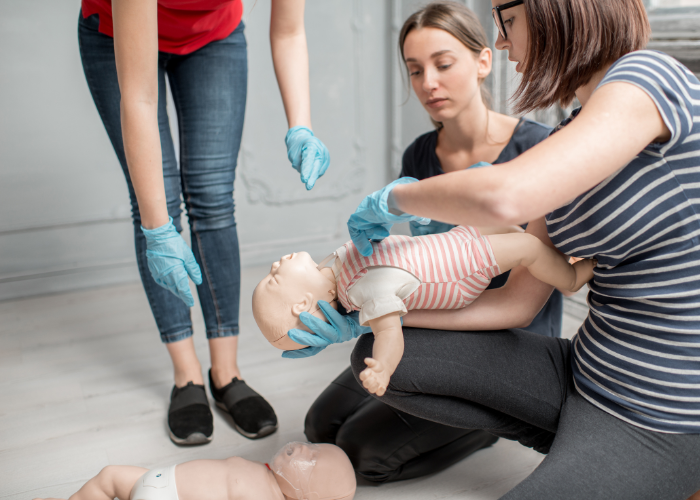
The techniques used in First Aid for children and babies differ significantly from those used for adults. Compression depths, rescue breath volumes, choking response, and medication doses are all different.
If you are a parent, grandparent, childminder, nursery worker, or primary school teacher, Paediatric First Aid training is one of the most valuable things you can do.
Our Paediatric First Aid course is RQF accredited, Ofqual regulated, and specifically designed for those caring for babies and children. It covers all of the scenarios above and many more, in a practical, supportive environment.
Bites, Stings and Allergic Reactions
Summer in the UK means spending more time outdoors, and with that comes an increased exposure to insects, marine life, and other creatures that bite or sting.
For most people, a sting or bite is painful and unpleasant but not dangerous. For others, it can trigger a severe, life-threatening allergic reaction known as anaphylaxis. Knowing the difference, and knowing what to do, is essential.
Bee and Wasp Stings
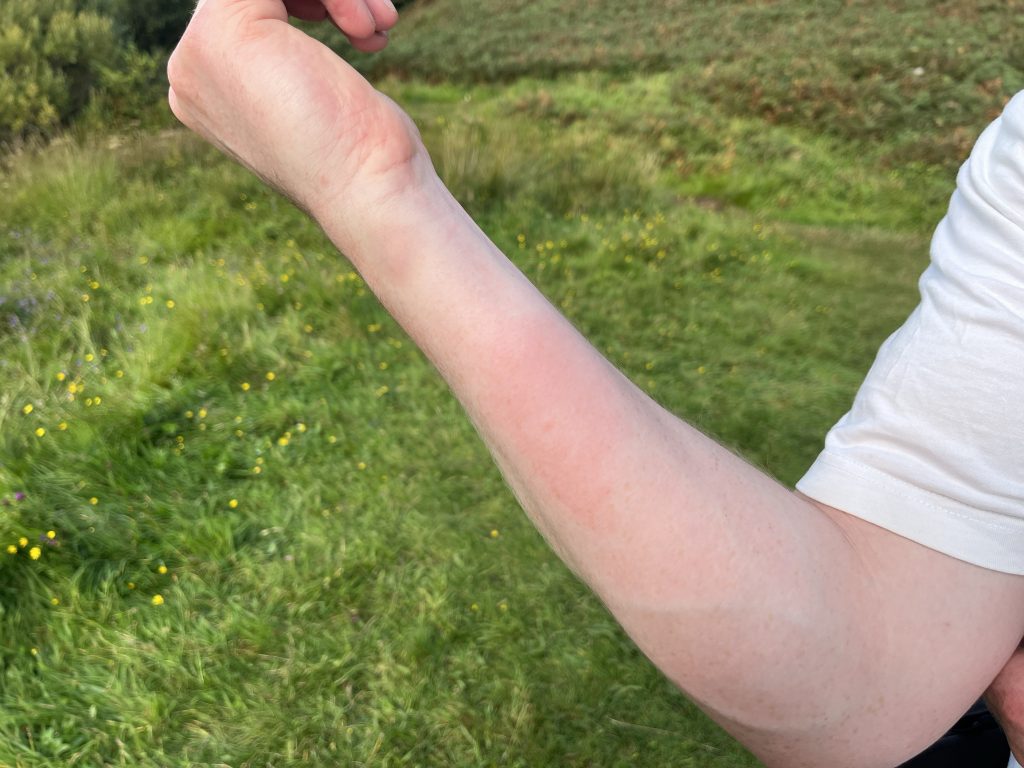
The British Beekeepers Association estimates there are around 24 million honeybee stings in the UK each year, with wasp stings accounting for many more. Most are painful but harmless.
However, around 5 people in the UK die from anaphylactic reactions to insect stings every year.
First Aid for a straightforward sting:
- Remove the sting as quickly as possible by scraping it sideways with a card or fingernail. Do not use tweezers as this can squeeze more venom into the skin
- Wash the area with soap and water
- Apply a cold compress or ice pack wrapped in a cloth to reduce swelling
- Raise the affected area if possible
- Antihistamine tablets or cream can help relieve itching and swelling
- Avoid scratching, as this can introduce infection
When a sting becomes an emergency:
Call 999 immediately if the person develops any of the following after a sting:
- Swelling of the face, lips, or throat
- Difficulty breathing or swallowing
- A widespread rash or flushing of the skin
- Dizziness, collapse, or loss of consciousness
- A rapid or weak pulse
- Nausea or vomiting combined with other symptoms
These are the signs of anaphylaxis. If an adrenaline auto-injector such as an EpiPen, Jext pen, or EURneffy nasal spray is available, administer it immediately and call 999. Do not wait to see if symptoms improve.
For a full guide to anaphylaxis recognition and response, including the three MHRA-approved adrenaline devices, visit our Benedict’s Law blog post.

Tick Bites and Lyme Disease
Ticks are small, spider-like creatures found in woodland, grassland, and heathland across the UK. They are most active between March and October and are increasingly common as milder winters allow their populations to grow.
Public Health England estimates that there are between 2,000 and 3,000 confirmed cases of Lyme disease in England and Wales each year, though the true number is thought to be considerably higher.
How to remove a tick safely:
- Use fine-tipped tweezers or a tick removal tool. Do not use petroleum jelly, nail polish, or heat
- Grasp the tick as close to the skin as possible
- Pull upwards with steady, even pressure. Do not twist or jerk
- Clean the bite area with antiseptic or soap and water
- Dispose of the tick by placing it in a sealed bag or container
Signs of Lyme disease to watch for:
- A circular, expanding rash around the bite (often described as a bullseye), which can appear anywhere from 3 to 30 days after the bite
- Flu-like symptoms including fatigue, headache, muscle and joint pain, and fever
If any of these symptoms develop after a tick bite, seek medical advice promptly. Early treatment with antibiotics is highly effective.
Jellyfish Stings
With millions of UK residents heading to the coast each summer, jellyfish stings are a surprisingly common First Aid situation.
The lion’s mane jellyfish, Portuguese man o’ war, and compass jellyfish are among the most frequently encountered species around UK coastlines and can cause significant pain and, in rare cases, a serious reaction.
First Aid for a jellyfish sting:
- Do not rub the affected area, as this can release more venom
- Rinse the area with seawater, not fresh water, as fresh water can trigger further venom release
- Carefully remove any visible tentacles using tweezers or a stick. Do not use bare hands
- Immerse the area in hot water (as hot as can be tolerated, around 45°C) for at least 30 minutes. This is now the recommended treatment and is more effective than the previously advised vinegar approach
- Seek medical advice if pain is severe, the sting covers a large area, or the person develops signs of an allergic reaction

Adder Bites
The adder is the UK’s only venomous snake and is found across heathland, moorland, and woodland. Adder bites are rare but do occur, particularly during summer months when adders are most active and people venture into their habitat.
Around 100 adder bites are reported in the UK each year, though fatalities are extremely rare.
What to do if someone is bitten by an adder:
- Keep the person calm and as still as possible to slow the spread of venom
- Call 999 or get them to hospital as quickly as possible
- Remove any watches, rings, or tight clothing near the bite in case of swelling
- Do not cut the wound, suck out the venom, or apply a tourniquet
- Note the time of the bite and, if safe to do so, take a photo of the snake for identification. Do not attempt to catch or handle it
Anaphylaxis: The Bigger Picture
Bites and stings are just one potential trigger for anaphylaxis. Common triggers in the UK also include foods such as peanuts, tree nuts, milk, eggs, and shellfish, as well as latex and certain medications.
Anaphylaxis UK estimates that around 20,000 people are admitted to hospital for anaphylaxis each year in England alone.
With the arrival of Benedict’s Law and the increasing profile of allergy awareness, there has never been a better time to ensure that you, your family, and your workplace are prepared.
Our First Aid courses at Lightning Training Solutions cover anaphylaxis recognition and emergency response in full, including the use of EpiPen, Jext, and EURneffy adrenaline devices.
You can read more in our dedicated Benedict’s Law guide or find out about our upcoming courses.

Travel First Aid: Be Prepared Before You Go
Every summer, millions of UK families load up the car, head to the airport, or set off on a road trip without giving a moment’s thought to First Aid. Yet travel, whether at home or abroad, brings its own specific risks.
A little preparation before you leave can make an enormous difference if something goes wrong along the way.
First Aid Kits in Vehicles: What Does UK Law Say?
Many people are surprised to learn that, unlike in several European countries, there is currently no legal requirement in the UK to carry a First Aid kit in a private vehicle.
However, the Highway Code strongly recommends it, and if you are driving a commercial vehicle or operating under certain industry regulations, requirements may apply.
If you are driving in Europe this summer, the rules are different. Many countries require drivers to carry a First Aid kit by law, including Germany, Austria, Croatia, France, Greece, and others.
Failure to carry one can result in an on-the-spot fine. Always check the specific requirements for every country on your route before you travel.
What Should a Vehicle First Aid Kit Contain?
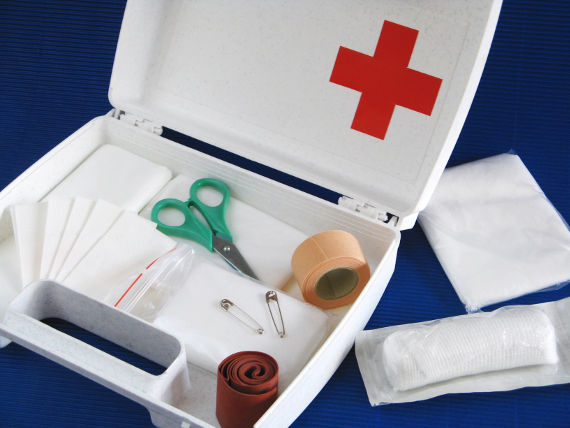
Whether it is a legal requirement or not, carrying a well-stocked First Aid kit in your vehicle is simply good sense. A basic vehicle First Aid kit should include:
- Sterile dressings in a range of sizes
- Triangular bandages
- Adhesive plasters (assorted sizes)
- Sterile eye wash and eye pad
- Disposable gloves (at least two pairs)
- A face shield or pocket mask for CPR
- Scissors and tweezers
- A foil emergency blanket
- A basic First Aid guidance card or booklet
- Any personal medications such as an inhaler or adrenaline auto-injector
If you are travelling with children, include child-appropriate plasters, infant paracetamol and ibuprofen, and a thermometer.
Travelling Abroad: Key First Aid Considerations
European Health Insurance Card (EHIC) and GHIC
Since Brexit, the old EHIC card is no longer issued to UK residents, though existing cards remain valid until their expiry date. It has been replaced by the Global Health Insurance Card (GHIC), which provides access to state healthcare in EU countries at a reduced cost or free of charge.
Critically, the GHIC is not a substitute for travel insurance. Always take out comprehensive travel insurance that includes medical cover, emergency repatriation, and adequate cover for any activities you plan to undertake.
Heat, Altitude, and Unfamiliar Environments
Travelling to hotter climates significantly increases the risk of heat-related illness, particularly in the first few days before the body has had time to acclimatise.
The advice in our Heat section above applies equally abroad, but the risks can be greater in extreme temperatures. Stay hydrated, avoid midday sun, and be particularly vigilant with young children and elderly relatives.
Food and Water Safety
Travellers’ diarrhoea affects up to 50% of people visiting high-risk destinations. Whilst rarely serious in healthy adults, it can cause rapid dehydration in children and older people. Oral rehydration sachets are an essential addition to any travel First Aid kit.
Pre-Travel Health Preparation
Before travelling abroad, visit your GP or a travel health clinic at least 6 to 8 weeks before departure to discuss vaccinations, antimalarials if applicable, and any destination-specific health advice.
The NHS Fit for Travel website is an excellent starting point.
Road Traffic Incidents: Initial Response
Sadly, the summer months see an increase in road traffic incidents, with more vehicles on the road and longer journeys being made. If you come across a road traffic incident, knowing what to do in the first few minutes can be the difference between life and death.
The initial response at a road traffic incident:
- Make the scene safe first. Switch on your hazard lights, park at a safe distance, and if safe to do so, switch off the ignition of any vehicles involved
- Call 999 immediately and give your precise location, the number of vehicles involved, and whether anyone appears to be injured
- Do not move casualties unless there is an immediate risk to life such as fire or fast-moving traffic. Moving an injured person incorrectly can worsen spinal injuries
- If a casualty is unresponsive and not breathing normally, begin CPR immediately
- Control any serious bleeding by applying firm, direct pressure with a clean cloth or dressing
- Keep casualties warm using a foil blanket or clothing and provide reassurance until emergency services arrive
- Do not remove a motorcyclist’s helmet unless their airway is compromised and you are trained to do so
Our Emergency First Aid at Work and First Aid at Work courses both cover the management of road traffic incidents, bleeding, and unconscious casualties in full, giving you the skills and confidence to act effectively in exactly these situations.
Vehicle Fires: What to Do in an Emergency
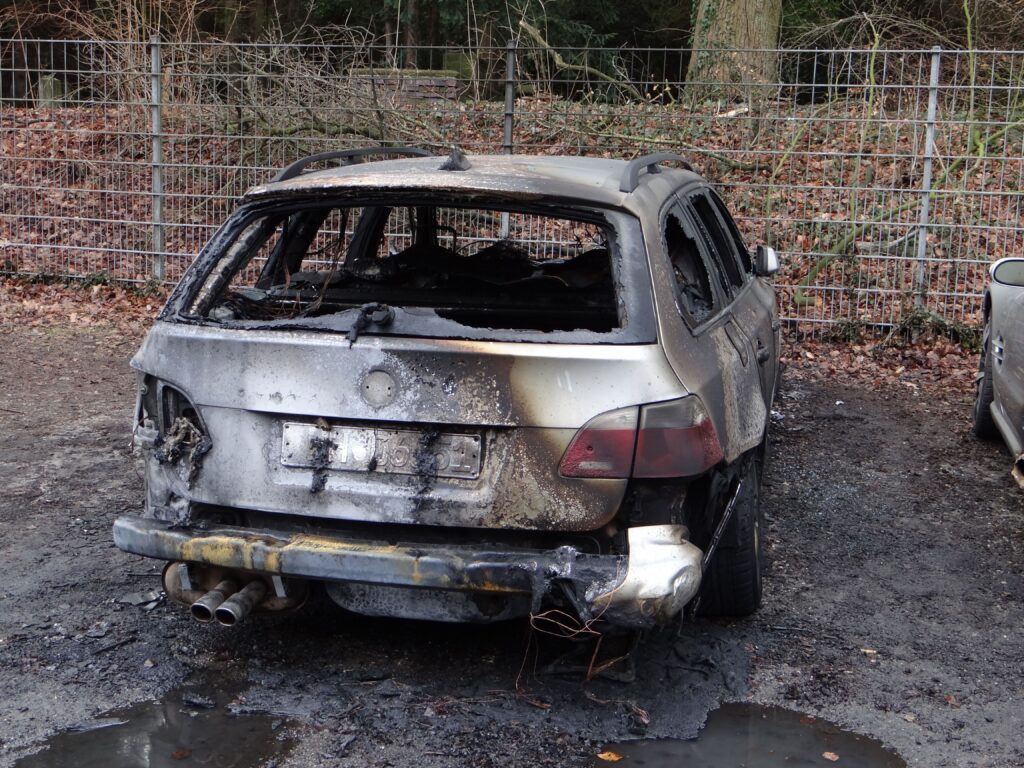
Vehicle fires are more common than most people realise, and they can escalate with terrifying speed.
The Department for Transport recorded over 2,100 vehicle fires attended by fire and rescue services in England in 2022 alone, and the real figure is thought to be considerably higher when unreported incidents are included.
With more electric vehicles on UK roads than ever before, the nature of vehicle fires is also changing, presenting new challenges for both drivers and emergency responders.
How Quickly Does a Vehicle Fire Spread?
This is perhaps the most important thing to understand about vehicle fires. A car can become fully engulfed in flames in as little as two minutes from ignition.
Modern vehicles contain large amounts of plastic, synthetic materials, and fuel, all of which burn rapidly and produce toxic smoke.
You have very little time to act, and every second counts.
Warning Signs of a Vehicle Fire
Being able to recognise the early signs of a vehicle fire gives you the best chance of getting everyone out safely before the situation becomes critical.
Watch out for:
- Smoke coming from the engine bay, wheels, or interior
- A strong smell of burning, petrol, or electrical burning
- Sparks or flames visible underneath the vehicle
- Unusual warning lights on the dashboard, particularly related to the engine or battery
- Rapid loss of power combined with a burning smell
What to Do if Your Vehicle Catches Fire
Step 1: Pull over immediately and safely
As soon as you notice any sign of fire or smoke, indicate, pull over to the left as safely and quickly as possible, and switch off the engine. Cutting the fuel supply can slow the spread of fire significantly.
Step 2: Get everyone out immediately
Do not stop to collect belongings. Get every passenger out of the vehicle as quickly as possible. If child locks prevent rear doors from opening, instruct children to climb over the front seats.
Step 3: Move well away from the vehicle
Move everyone at least 100 metres away from the vehicle and well away from the road. Fuel tanks can explode, and flying debris can travel significant distances. Do not stand behind or in front of the vehicle.
Step 4: Call 999
Call 999 immediately and report the vehicle fire, your location, and whether anyone is injured. Do not return to the vehicle for any reason.
Step 5: Do not attempt to fight the fire yourself
Unless the fire is very small, contained, and you have a suitable fire extinguisher immediately to hand, do not attempt to tackle a vehicle fire yourself. The risks are extreme. Your priority is to get people to safety, not to save the vehicle.
Should I Have a Fire Extinguisher in My Car?
As with First Aid kits, there is currently no legal requirement to carry a fire extinguisher in a private vehicle in the UK. However, many motoring organisations recommend it, particularly for longer journeys or when travelling in remote areas.
If you do carry one, a dry powder or AFFF foam extinguisher rated for Class B fires (flammable liquids) is most appropriate for vehicle use.
Critically, a fire extinguisher should only ever be used on a very small, contained fire, for example a smouldering engine, and only if you can do so without putting yourself at risk and with a clear escape route behind you.
If there is any doubt at all, get away from the vehicle and call 999.
Electric Vehicle Fires: What You Need to Know
Electric vehicles (EVs) present specific challenges in the event of a fire.
Lithium-ion battery fires, known as thermal runaway, can be extremely difficult to extinguish, can reignite hours or even days after apparently being put out, and produce highly toxic smoke.
If you are driving an electric vehicle and suspect a battery fire:
- Pull over and stop the vehicle immediately
- Get all occupants out and move at least 100 metres away
- Call 999 and specifically tell the operator that the vehicle is electric
- Do not attempt to open the bonnet or touch the battery
- Be aware that the vehicle may reignite even after the fire appears to have been extinguished
The number of EVs on UK roads passed one million in 2023, and this figure is growing rapidly. Awareness of EV-specific fire risks is becoming an increasingly important part of road safety knowledge for all drivers.

Treating Burns at the Scene
If someone sustains burns as a result of a vehicle fire, prompt and correct First Aid can significantly reduce the severity of the injury and the person’s recovery time.
First Aid for burns:
- Move the person away from the source of heat immediately, ensuring the scene is safe for you to do so
- Cool the burn under cool running water for a minimum of 20 minutes. Do not use ice, butter, toothpaste, or any other substance
- Remove any clothing or jewellery near the burn, unless it is stuck to the skin
- Cover the burn loosely with cling film, a clean plastic bag, or a sterile non-fluffy dressing. Do not wrap it tightly
- Call 999 or take the person to hospital for any burn larger than the size of the casualty’s hand, any burn to the face, hands, feet, genitals, or joints, any burn caused by chemicals or electricity, or any burn in a child or elderly person
Do not burst any blisters that form, as this increases the risk of infection.
Burns are covered in detail on both our Emergency First Aid at Work and First Aid at Work courses, alongside a wide range of other emergency scenarios you might encounter at the roadside or in the workplace this summer.
Building Your Summer First Aid Kit
A well-stocked First Aid kit is one of the simplest and most effective things you can do to prepare for a summer emergency. Yet research by the British Red Cross found that fewer than half of UK households own a First Aid kit, and many of those that do contain out-of-date or incomplete supplies.
Whether you are heading abroad, spending the day at the beach, or simply enjoying the garden, having the right supplies to hand means you can respond quickly and effectively when it matters most.
The Core Summer First Aid Kit
These are the essentials that every household and vehicle should have available throughout the summer months:
| Item | Why You Need It |
|---|---|
| Sterile dressings (assorted sizes) | Covering wounds and controlling bleeding |
| Adhesive plasters (assorted sizes) | Minor cuts, grazes and blisters |
| Triangular bandages (x2) | Slings, securing dressings, and immobilising injuries |
| Disposable gloves (several pairs) | Infection control when treating any wound |
| Sterile eye wash and eye pad | Sand, insects, chemicals, or foreign bodies in the eye |
| Scissors and tweezers | Cutting dressings, removing splinters and ticks |
| Foil emergency blanket | Preventing shock and hypothermia |
| CPR face shield or pocket mask | Safe delivery of rescue breaths |
| Antiseptic wipes and cream | Cleaning minor wounds to prevent infection |
| Oral rehydration sachets | Treating dehydration from heat, illness or travel sickness |
| Digital thermometer | Monitoring temperature in children and adults |
| First Aid guidance booklet | Quick reference in a stressful situation |
Additional Items for Families with Children
If you are travelling or spending time outdoors with young children, the following additions are strongly recommended:
- Child-appropriate adhesive plasters (smaller sizes and fun designs can help with anxious children)
- Infant and child paracetamol and ibuprofen in appropriate doses
- An oral syringe for administering liquid medication accurately
- Nappy rash cream, which can also soothe mild sunburn
- After-sun lotion
- Calamine lotion for insect bites, stings, and sunburn
- A tick removal tool, particularly if walking in woodland or grassland
Additional Items for Outdoor and Travel Use
For camping trips, hiking, or travel abroad, consider adding:
- Blister plasters and moleskin padding
- Insect repellent (DEET-based for high-risk destinations)
- Antihistamine tablets for allergic reactions and hay fever
- A cold compress or instant ice pack
- Waterproof plasters and dressings
- A whistle for attracting attention in remote areas
- Any personal prescription medications, with enough supply for the full trip plus extra in case of delays
Prescribed Emergency Medication
If you or anyone in your group has a known allergy, asthma, or other medical condition, ensure that all prescribed emergency medication is packed, in date, and easily accessible. This includes:
- Adrenaline auto-injectors such as EpiPen, Jext, or EURneffy, carrying at least two at all times
- Reliever inhalers for asthma
- Any other prescribed emergency medication
Make sure at least one other person in your group knows where the medication is stored and understands how to use it. Our First Aid courses cover the use of all three adrenaline devices in full. For more information, visit our Benedict’s Law guide.
Maintaining Your First Aid Kit
A First Aid kit is only as good as its contents. Get into the habit of checking your kit at the start of each summer season and replacing anything that has expired, been used, or become damaged. Key things to check include:
- Expiry dates on dressings, plasters, eye wash, and medications
- That gloves have not perished or degraded
- That scissors and tweezers are clean and functional
- That your CPR face shield is intact and accessible
Where to Buy a First Aid Kit
Pre-assembled First Aid kits are widely available from pharmacies, supermarkets, and online retailers. Look for kits that conform to the British Standard BS 8599, which sets out the recommended contents for workplace and travel First Aid kits.
You can also build your own kit by purchasing individual items, which allows you to tailor the contents to your specific needs.
Be Prepared: First Aid Training with Lightning Training Solutions
Reading a First Aid guide is a brilliant starting point. But there is a significant difference between knowing what to do in theory and being able to act quickly, calmly, and correctly when someone in front of you needs help.
That confidence only comes from hands-on, practical training.
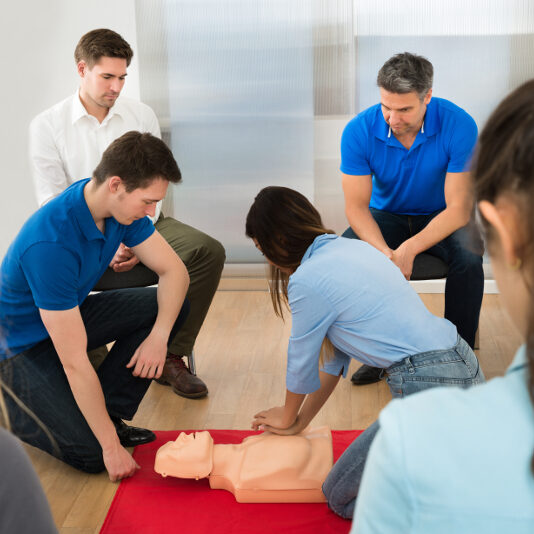
At Lightning Training Solutions, we provide accredited, practical First Aid training in Yeovil, Somerset, delivered by experienced instructors in a friendly and supportive environment. Whether you are a complete beginner or looking to renew an existing qualification, we have a course to suit you.
Our Courses
Emergency First Aid at Work (EFAW) £70 + VAT per person
Our one-day EFAW course is the ideal starting point for anyone who wants to build genuine First Aid confidence. It covers all of the core emergency scenarios you are most likely to encounter, including:
- CPR and use of an AED defibrillator
- Managing an unresponsive casualty
- Choking and airway management
- Bleeding, wounds, and shock
- Anaphylaxis recognition and use of adrenaline auto-injectors
- Seizures and other medical emergencies
- Burns and scalds
The EFAW is suitable for individuals, employees, parents, and anyone who simply wants to be better prepared. Certificates are valid for three years.
First Aid at Work (FAW) £180 + VAT per person (includes blended learning)
Our three-day FAW qualification is the gold standard in workplace First Aid and is the recommended course for designated First Aiders, managers, and those with responsibility for health and safety. It covers everything in the EFAW, plus:
- Fractures, dislocations, and soft tissue injuries
- Chest injuries and breathing difficulties
- Stroke and seizure response
- Diabetes, asthma, and other medical conditions
- Spinal injury awareness
- Anaphylaxis management in depth, including EpiPen, Jext, and EURneffy
- Minor injuries and ongoing casualty care
Certificates are valid for three years. This qualification meets your legal obligations under the Health and Safety (First Aid) Regulations 1981.
Paediatric First Aid (PFA) £75 + VAT per person
Specifically designed for anyone working with or caring for babies and children, our Paediatric First Aid course is essential for parents, grandparents, childminders, nursery staff, teachers, and after-school club workers. It covers:
- Paediatric CPR and AED use for children and infants
- Choking in babies, toddlers, and older children
- Anaphylaxis and adrenaline auto-injector use in children
- Febrile seizures and epilepsy
- Burns, scalds, and wound management in children
- Meningitis recognition in young children
- Managing an unresponsive child or baby
- The recovery position for infants and children
The course is RQF accredited, Ofqual regulated, and meets Ofsted and EYFS requirements. Certificates are valid for three years.
Forestry Element Add-On
For those working in forestry, arboriculture, or land management, we offer a forestry-specific add-on to both our EFAW and FAW courses:
- EFAW with Forestry Elements: £90 + VAT per person
- FAW with Forestry Elements: £210 + VAT per person
These supplements cover the specific First Aid scenarios encountered in forestry and outdoor working environments, including chainsaw injuries, remote location response, and working in isolated conditions.
Moving of People and Basic Life Support (BLS) £75 + VAT per person
Our Moving of People and BLS course is ideal for those who need specific training in the safe movement and handling of casualties alongside core life support skills.
This course is particularly relevant for those working in care settings, schools, and any environment where manual handling of people may be required in an emergency.
Upcoming Autumn Courses
Our summer courses are filling up fast, and our autumn schedule is now live. All courses are held at:
📍 The Masonic Hall, 23 Hendford, Yeovil, BA20 1TQ
⏰ 9:15am to 4:15pm
| Date | Course | Status |
|---|---|---|
| 16th September | EFAW | ✅ Spaces available |
| 17th September | EFAW and FAW (blended) | ❌ Fully Booked |
| 21st September | EFAW | ✅ Spaces available |
| 25th September | EFAW | ❌ Fully Booked |
| 26th September | Paediatric First Aid (blended) | ❌ Fully Booked |
| 5th and 6th October | EFAW and FAW (blended) | ✅ Spaces available |
| 17th October | Paediatric First Aid (blended) | ✅ Spaces available |
| 20th October | EFAW | ✅ Spaces available |
| 27th and 28th October | EFAW and FAW (blended) | ✅ Spaces available |
| 3rd and 4th November | EFAW and FAW (blended) | ✅ Spaces available |
| 10th November | EFAW | ✅ Spaces available |
| 21st November | Paediatric First Aid (blended) | ✅ Spaces available |
| 24th November | EFAW | ✅ Spaces available |
| 1st and 2nd December | EFAW and FAW (blended) | ✅ Spaces available |
| 5th December | Paediatric First Aid (blended) | ✅ Spaces available |
| 17th December | EFAW | ✅ Spaces available |
Can’t Make Any of These Dates?
No problem. Get in touch with our team and we will do our best to find a solution that works for you.
We also offer bespoke in-house training for organisations that need to train larger numbers of staff at their own premises.
Book Your Place Today
📞 Call us: 01935 473575 or 07910 407443
📧 Email: admin@lightningtrainingsolutions.co.uk
🌐 Book online: lightningtrainingsolutions.co.uk/blog/events/